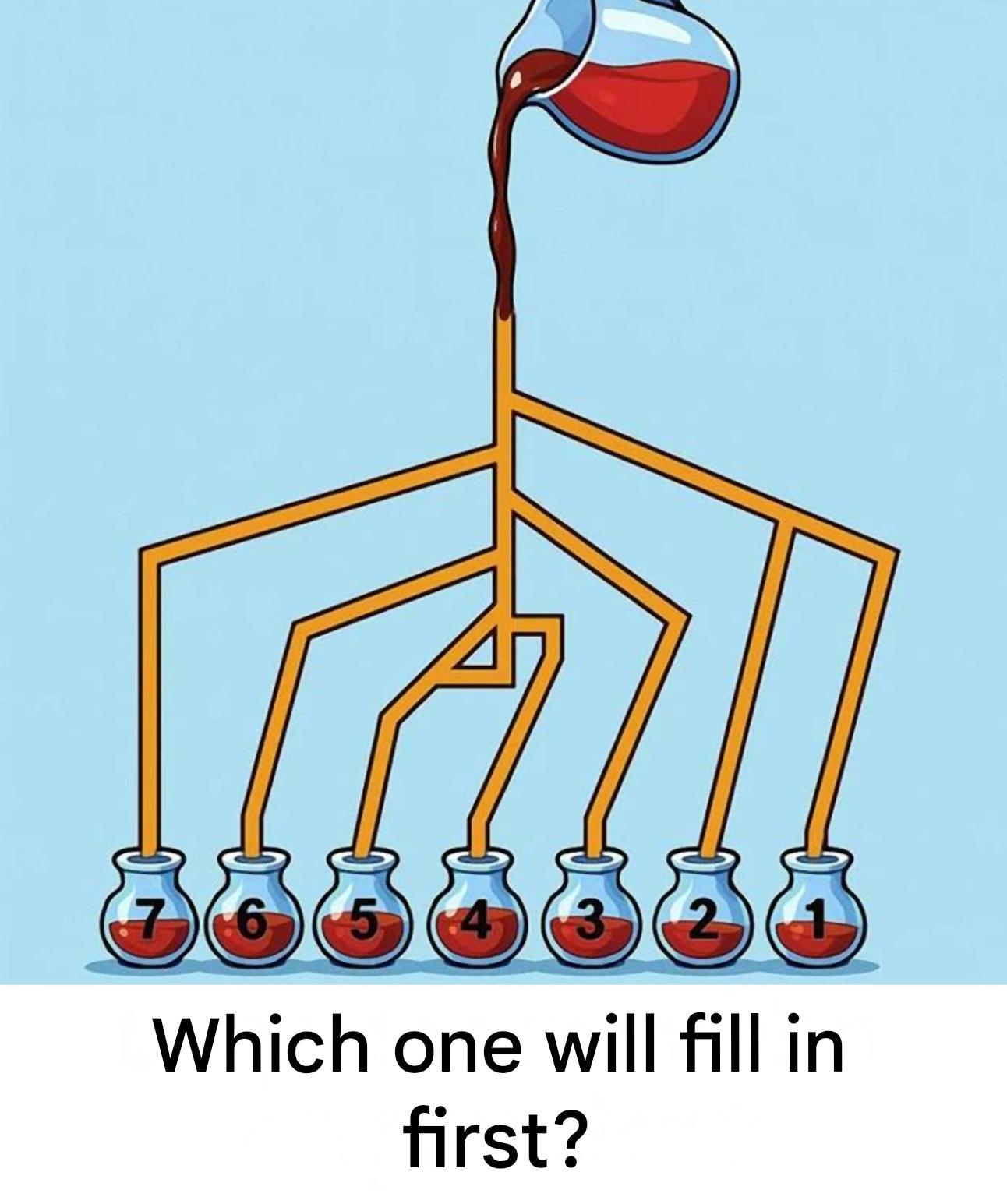

Imagine the scene: the tap opens, the flow descends and separates into two main directions, left and right.
On the left: the path to containers 7, 6, 5, 4 is longer and more winding, with more turns and detours.
On the right: the flow is clearly more direct, leading to 3, 2 and 1 via shorter pipes.
In the right-hand branch, the pipe then divides into three vertical pipes. The one closest to the junction is the one for container 3: it is lower, shorter, and unobstructed. The pipes to 2 and 1, however, branch off lower down or take a longer route, which delays their filling.
Verdict: container #3 fills up first.
Why does this result seem “magical” (when it is actually logical)?
Our brains like to extrapolate by eye: we imagine that the water spreads everywhere at the same time. In reality, it favors the path of least resistance . Container 3 has several advantages: direct access, no blockage, a low inlet height, and a short distance to travel. As long as container 3 isn't saturated at the outlet (if it has one), it captures most of the initial flow.
Train your eye: a quick checklist to apply to all versions

- Look for the dams: a tiny line can mean “blocked”.
- Note the levels: a branch that rises above the liquid cuts off the flow.
- Count the bends: the more there are, the greater the pressure loss.
- Measure the proximity of the first vertical pipe after the main branch.
- Be patient: the puzzle rewards thoroughness, not haste.